What you're looking at
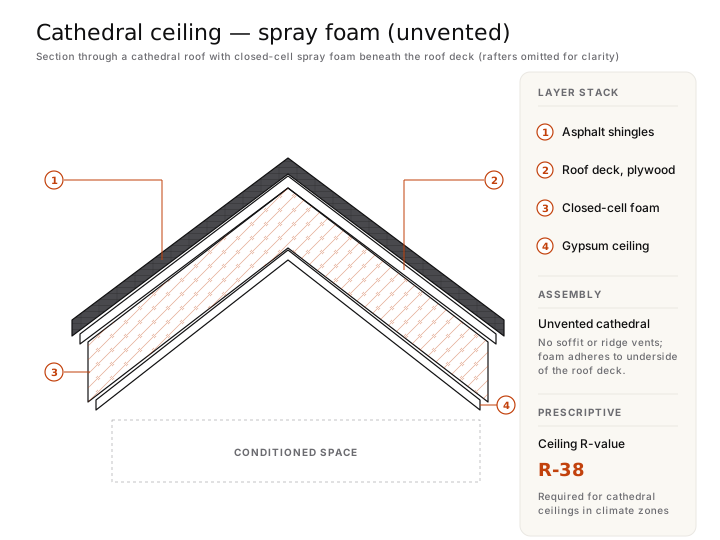
A section cut through a vaulted cathedral roof finished as an unvented assembly. From outside to inside the layers are asphalt shingles, a plywood roof deck, a thick band of closed-cell spray polyurethane foam adhered directly to the underside of the deck, and a gypsum ceiling. The rafters that would frame the cavity are omitted so the foam layer reads cleanly; in construction the foam fills the cavity flush with the underside of each rafter.
The "X" markers at the ridge and both eaves call out what is intentionally not there: no ridge vent, no soffit vents, no attic plenum above the ceiling. The conditioned space sits directly under the gypsum, and the spray foam is what carries both the air barrier and the thermal control layer in one application.
When this matters
Cathedral ceilings are the standard answer when a designer wants the interior volume to follow the roof slope — open-beam great rooms, vaulted master suites, lofted ADUs. The unvented closed-cell foam approach lets you hit the prescriptive ceiling R-value (R-38 in most California climate zones) without the deep rafter depth a vented assembly with batts would need, and without the soffit-to-ridge airflow path a vented cathedral requires. It is also the cleanest answer for complex hip-and-valley roofs where continuous vent channels are awkward to detail.
Closed-cell foam earns its place by doing three jobs at once: insulation, air barrier, and vapor retarder. For unvented cathedral assemblies in California, the foam must be in direct contact with the underside of the deck — any air gap defeats the moisture-control intent and can let condensation form on the cold underside of the sheathing.
Related
- Vented attic with R-38 ceiling and radiant barrier — the alternative when the ceiling is flat below an attic plenum.
- Wall section, R-21 cavity + R-5 continuous insulation — companion envelope detail for the same prescriptive package.