What you're looking at
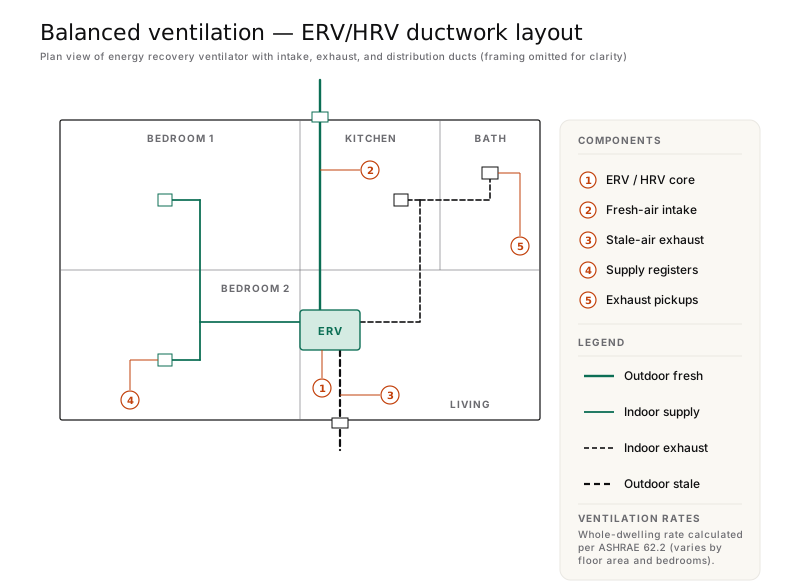
A residential floor plan with a central Energy Recovery Ventilator (ERV) — or Heat Recovery Ventilator (HRV) — tucked into a small utility closet at the heart of the layout. The unit runs four ducts:
- Outdoor fresh (heavy teal) — pulls outside air in through a hood on the north wall and delivers it to the ERV core.
- Indoor supply (medium teal) — distributes the now-tempered fresh air to each sleeping room through ceiling registers.
- Indoor exhaust (thin dashed ink) — picks up stale, moist air from the kitchen and bathroom ceilings and brings it back to the ERV core.
- Outdoor stale (heavy dashed ink) — pushes the picked-up stale air back outside through a hood on the south wall, after the core has stripped most of its heat (and, for an ERV, moisture) and transferred it to the incoming fresh airstream.
Because the supply and exhaust airflows are matched, the house stays at neutral pressure — no make-up air pulled in through cracks, no conditioned air leaked out under the doors.
When this matters
California Title 24 requires mechanical whole-dwelling ventilation in every new single-family home and addition over a threshold size, sized per ASHRAE 62.2 (typically around 50–80 cfm continuous for a mid-sized house). A bath fan running all the time satisfies the code on paper but is exhaust-only — it pulls outdoor air in through whatever cracks exist in the envelope, which gets unpleasant fast in hot or smoky climates. A balanced ERV or HRV is the upgrade most designers reach for when:
- The building is in a tight climate zone (climate zone 1 or 16) where heat loss from continuous exhaust is expensive.
- The site has poor outdoor air quality (wildfire-prone areas) and the homeowner wants every cubic foot of fresh air filtered.
- The Hybrid or High-Performance Envelope option is chosen and the airtightness target makes uncontrolled infiltration insufficient.
ERVs additionally moderate humidity transfer, which matters in climate zones 1, 3, and 5 (coastal) where summer fresh air is often more humid than indoor air the homeowner wants to maintain.
Related
- HVAC topology — central heat pump + extended ducts (companion plan view for primary conditioning)
- High-Performance Envelope (the airtightness target that typically drives ERV/HRV adoption)